
From Struggle to Studio: How Four Track Lights Replaced a Full Lighting Grid
Updated: Aug 10
Not every studio has the luxury of high ceilings — but that shouldn't limit what a space can produce. This is the story of how a compact, low-ceiling room was transformed into a fully camera-ready studio using just four RGB track lights, and why this approach is now being rolled out across podcast rooms, interview sets, and broadcast studios nationally.

The Problem: Low Ceilings, High Expectations
Studio managers and content teams increasingly need broadcast-quality output from rooms that were never built for it. Traditional studio lighting — key, fill, background, hair, and overhead butterfly — is normally achieved with multiple stand-mounted fixtures spread through a room. That approach needs vertical clearance and floor space, and it puts cables and stands directly in the path of talent, crew, and camera.
In a low-ceiling room, that setup simply doesn't work. The old assumption was that compact spaces had to settle for compact results.
The Solution: A Studio Grid, Not Architectural Lighting
The answer wasn't more lights — it was smarter lights.
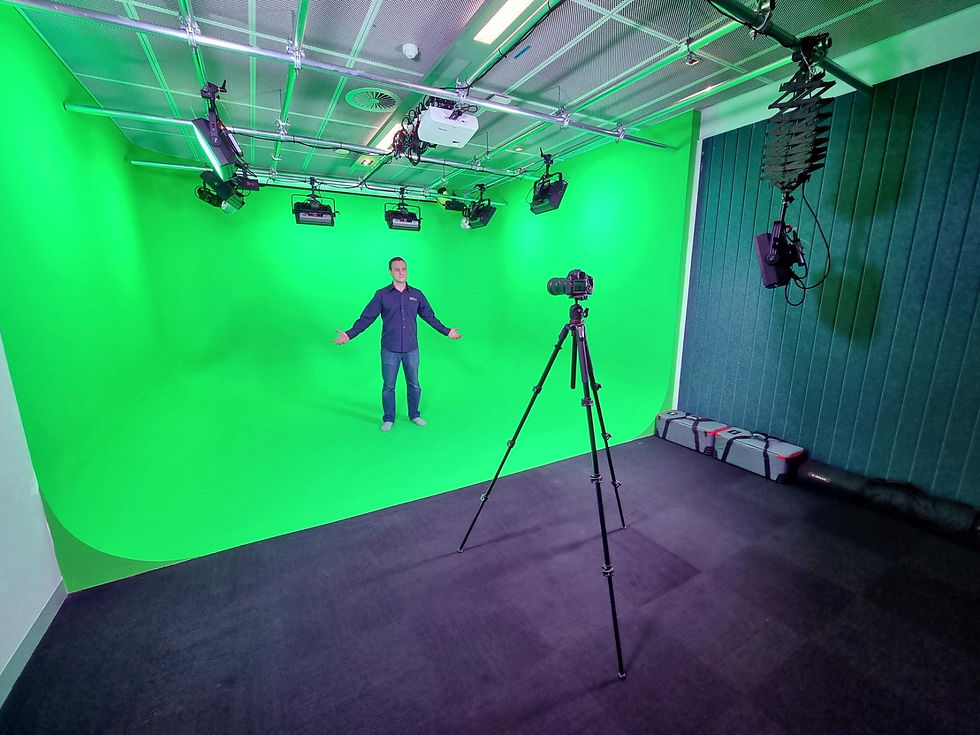
Four RGB track lights were engineered and installed to function as a complete studio lighting grid, not as architectural lighting repurposed for video. This is the core distinction: ordinary track lighting illuminates a room. This system is a professionally designed, camera-ready studio lighting solution built specifically for compact spaces.

More Than 300° of Rotation, One Fixture, Five Jobs
Each track light rotates more than 300 degrees. In practical terms, that means a single fixture can be re-aimed on the spot to serve as:
Key light — the main source shaping the subject
Fill light — softening shadows for a balanced look
Background light — separating subject from backdrop
Hair light — adding definition and depth
Overhead butterfly light — soft, flattering top-down illumination
That's five distinct lighting roles, covered by four fixtures. A crew isn't limited to one fixed look — they can reshape the entire lighting design of the room in minutes, without touching a stand, a gel, or a ladder.
Clear Floors, No Light Stands
Because everything is ceiling-mounted, floors stay completely clear. There's nothing for talent to navigate around, nothing for camera operators to work past, and nothing that limits how a room can be furnished or laid out between shoots. For interview sets, podcast rooms, and multi-use spaces, this alone is often the deciding factor.
Independent Channel Control, One Remote
Every track light is controlled independently, but all four channels are managed from a single handheld remote. From that one remote, a crew can adjust:
Dimming
Colour temperature
RGB colour
Hue
Saturation
That means the entire look and feel of the room — from a clean white interview setup to a saturated colour treatment — can be reset in seconds, not rebuilt from scratch.

True Chroma-Key Capability, Built In
The system holds a genuine Hue 120 green, giving the room full chroma-key capability without needing a separate background light, a dedicated green screen kit, or additional equipment. The track lighting itself becomes the green screen lighting — one less setup step, one less piece of gear to source, store, and maintain.
Fast, Repeatable Setup
Because every configuration is remote-controlled and pre-tunable, the system is built for speed and consistency. A crew can move between a white-light interview look, an RGB-saturated set, and a chroma-key background in the same session, with results that are repeatable every single time — no relighting from scratch, no guesswork, no colour drift between sessions.

Where This System Fits
This isn't a niche solution for one type of content. The same four-light grid supports:
Podcasts — clean, consistent lighting for long-form recording
Interviews — flattering key/fill/background separation without a large footprint
Social media content — fast colour and mood changes to match different content styles
Corporate video — professional, broadcast-grade output for internal and external communications
Whether the room is used for one format or rotates through several in a single day, the lighting adapts rather than the room having to be rebuilt around it.
Proven at Scale: SBS and Beyond
This approach isn't experimental — it's been supplied and installed in hundreds of track lighting projects, including recent studio builds for SBS. That track record matters: it shows the system scales from a single low-ceiling room to full broadcast studio environments, without compromising on the professional standard those environments demand.

The Numbers Behind the Look
For teams who want the detail behind the results, independent performance testing on the broader LightPro Low Ceiling system backs up what's visible on camera:
Bright enough for broadcast — light output on par with professional, high-ceiling studios (LUX 1174)
True-to-life colour — skin tones and backgrounds render accurately straight out of the camera, with no correction needed (TLCI 98.3)
Flattering, natural balance — a soft, neutral white balance tuned to be genuinely flattering on screen (Duv -0.0029)
Rich, vivid colour — subjects and backgrounds stay vibrant and true, never flat or washed out (Rg 101.7)
These figures exist for teams who want to validate the system technically — but the everyday takeaway is simpler: the room looks professional, on camera, every time, regardless of who's operating it or what content is being shot that day.
The Bigger Picture
A low ceiling used to mean a compromise. This system removes that trade-off entirely — giving compact rooms the flexibility, speed, and visual quality of a much larger studio lighting grid, without the stands, the cabling, or the rebuild time between shoots.
For studio managers and content teams evaluating a low-ceiling space, the question isn't whether the room can support professional lighting anymore. It's how much flexibility that room can offer once the right system is in place.
Interested in what this could look like in your space? Get in touch with the Dragon Studio Solutions team to discuss a design tailored to your room.

Really interesting transformation! It's impressive how a simpler lighting setup achieved such professional results. I enjoy reading behind-the-scenes content like this, and somehow ended up here after searching with a morse code translator. Great insights throughout.
Great transformation story! It's impressive how a smart lighting setup can improve both workflow and production quality. Thanks for sharing your experience. I also like using Toolarsh Online Tools for practical web-based utilities.