
Green Screen or White Cyclorama — Which Should You Choose?
- Angelo Boutsalis
- Jun 5
- 2 min read

Green screen and white cyclorama are not interchangeable options for the same outcome. They solve fundamentally different production problems. Choosing the wrong one affects your workflow, your post-production budget, and the skill level required to operate the studio every day.
What each one actually does
White cyclorama
Creates a seamless, infinite background directly in-camera. When correctly lit, the floor-to-wall transition disappears completely. No post-production required to achieve the infinity look. The standard background for ecommerce photography, fashion, commercial product work, and premium corporate video.
Green screen
Produces a solid-colour background that post-production software isolates and replaces with any digital environment. The right tool for broadcast, virtual sets, educational content with digital backgrounds, and creative productions where the background needs to be something that cannot be built in a physical space.
Head-to-head comparison
Factor | White cyclorama | Green screen |
Post-production | Minimal — background finished in-camera | Significant — every shot must be keyed and composited |
Lighting difficulty | Moderate — requires even background lighting | High — must be evenly lit with no hot spots, spill, or wrinkles |
Consistency | Very high — same result every session once locked | Variable — dependent on lighting consistency and key quality |
Skill required | Moderate — learnable by non-specialists | Higher — requires chroma key lighting and compositing knowledge |
Best for | Ecommerce, fashion, commercial photography, video on white | Broadcast, virtual sets, education, creative productions |
Durability | Long-lasting with correct paint and curve radius | Painted wall durable; fabric screens wrinkle and are hard to light evenly |
The post-production cost people underestimate
A painted green wall costs less than a built cyclorama upfront, so green screen appears to be the budget option. It is not, once compositing time is counted. A clean key might take 5 minutes per clip. A difficult key — uneven lighting, green spill, fabric wrinkles — can take 30 minutes or more. Multiplied across a year of production, the overhead regularly exceeds the construction cost difference.
The dual-studio solution
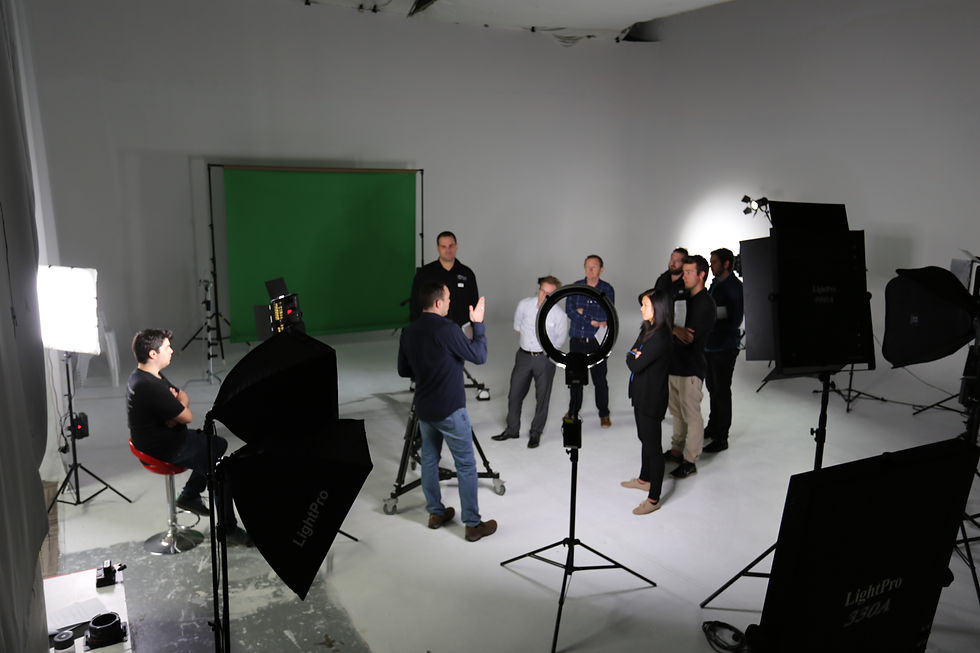
William Clarke College is a good example of doing both: dual studio configuration with white cyclorama and green screen, pantograph ceiling tracks, and a blackout curtain divider so two classes can shoot simultaneously. Photography, video, chroma key work, and mixed-use productions — without compromising either capability.
We have used this dual approach at a number of school and multi-use studio builds across Australia, including at Somerset College, Moriah College, and several other campuses where curriculum demands both capabilities.
Green screen: painted wall vs fabric
In any permanent studio installation, choose a painted wall over a fabric screen. Fabric wrinkles immediately and requires constant re-steaming. Under studio lighting, even small wrinkles create shadow variations that make the key difficult. A wall painted with Rosco Chroma Key Green provides a perfectly smooth, consistently coloured surface that keys cleanly every time — no maintenance beyond occasional repainting.
Our recommendation
For most Australian businesses building a permanent studio — ecommerce brands, corporate communications teams, schools — start with a white cyclorama. Add green screen if your content explicitly requires it, and build it as a permanent painted wall. Dragon Studio Solutions has built white cyclorama studios, green screen studios, and dual configurations across Sydney, Melbourne, and Brisbane.


Honestly, the point about post-production costs is spot on. I always prefer the browser demo for quick tests, but for real play scritchy scratchy online projects, you need that perfect white cyclorama setup.