
What Size Cyclorama Should I Build?

Building a cyclorama too small is the most regretted studio decision we see. Unlike a lighting system you can upgrade or a background system you can replace, a cyclorama is structural — once it is built, changing its size means demolition and reconstruction. Getting the sizing right the first time is an economic necessity.
The variables that determine cyclorama size
Subject size
Measure your largest subject first. A cyclorama for product photography must accommodate your largest product. For full-body fashion it must accommodate a standing person with room to move. For automotive work it must accommodate the full vehicle plus the ability to light around it.
Camera distance
The variable most people underestimate. You need camera distance behind the subject to control perspective. Standard lenses (50mm to 85mm) require 3 to 5 metres between camera and subject for full-body work. Telephoto lenses (85mm to 135mm) require 5 to 8 metres or more. Total room depth is: cyclorama shooting zone plus camera-to-subject distance plus space for crew and equipment — almost always larger than initial estimates.
Lighting zone
Background lights need 1 to 2 metres of clear space between the subject and the background wall. If the subject is immediately in front of the wall, you cannot separate subject lighting from background lighting — and the even white infinity look becomes impossible to achieve.
Recommended sizes by use case
Use case | Minimum cyc width | Recommended room depth | Configuration |
Product photography (tabletop) | 2.5m – 3m | 4m – 5m total | Single wall or corner |
Portrait / headshot studio | 3m – 4m | 5m – 6m total | Corner cyclorama |
Full-body fashion photography | 4m – 6m | 7m – 9m total | Corner or U-shape |
Ecommerce video (person on camera) | 4m – 5m | 6m – 8m total | Corner or U-shape |
Corporate video / broadcast | 3m – 4m | 5m – 7m total | Corner or single wall |
Commercial photography multi-use | 5m – 7m | 8m – 12m total | U-shape strongly recommended |
Vehicle / automotive | 8m – 12m+ | 12m – 16m+ total | U-shape, full wrap |
Cyclorama configuration: which shape for which room
Configuration | What it is | Best for |
Single wall | One curved wall with floor transition | Tight spaces, product photography, portrait close-ups |
Corner (L-shape) | Two walls meeting at a corner, both with curved transitions | Most commercial studios — versatile, space-efficient, handles full-body work |
U-shape | Three walls, full wrap | Large commercial, fashion, automotive — 360-degree lighting flexibility |
Full wrap | All four walls curved | Specialist large-format work |
Real build dimensions
Chasing Cars automotive studio: 10m x 8m U-shape white cyclorama with a 6m x 8m overhead softbox. The U-shape allows a full-size vehicle to be positioned centrally and lit from all three sides simultaneously.
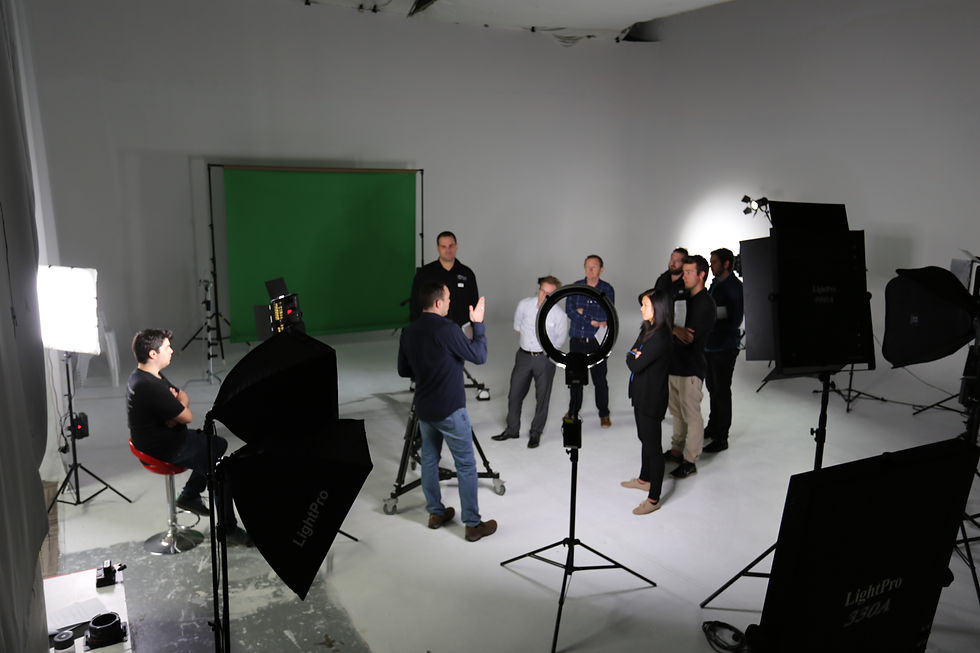
William Clarke College dual studio: approximately 5m wide white cyclorama and matching green screen studio, separated by a blackout curtain. Supports multiple student groups shooting simultaneously.
Forcast fashion studio: 5m wide corner cyclorama, ceiling-mounted overhead lighting, motorised background system. Sized for single-model full-body fashion with sufficient camera distance for 85mm portrait work.
What to do if your room is smaller than ideal
Smaller rooms do not mean no cyclorama — they mean a different configuration. A tight corner cyc in a 5m x 5m room, used with a 50mm lens and deliberate framing, can produce professional commercial results. The key is designing the lighting around the constraint. Dragon Studio Solutions has built effective cyclorama studios in rooms well under 30 square metres. We will tell you honestly if a cyclorama is not the right solution for your room. Contact us in Sydney, Melbourne, or Brisbane.


Comments